APAC's regulatory reset: The granular data mandate
From fragmentation to unification
For years, regulatory reporting in the Asia-Pacific region was defined by a patchwork of national rules and a reliance on static, template-based filings. For banks, this created a never-ending game of catch-up: a perpetual state of frantic reaction narrowly focused on compliance, not strategy.
That era is now giving way to a shift in how regulators approach supervision, with a stronger focus on modernizing their infrastructure to improve oversight. As a result, the move from manual processes to direct, automated reporting is gradually phasing out legacy methods.
Unlike Europe’s harmonized IReF framework, APAC’s regulatory reset is unfolding across a fragmented landscape — a challenge highlighted in a recent Chartis report on the region’s transformation of regulatory reporting. National regulators are modernizing their supervisory infrastructure, aligned with governance standards such as BCBS 239, and expanding mandates for ESG disclosure. Despite their different starting points, these regulators are converging on a common principle: shifting from aggregated reports to granular, machine-readable data. This evolution is fostering a standardized, data-centric architecture, empowering supervisors to adopt a "Collect Once, Use Many" model, and compelling banks to respond strategically with flexible approaches that can adapt to constant regulatory change.
The granular data mandates sweeping across APAC are creating a major paradox: while the principles are converging, the jurisdictional rules remain fragmented. This reactive, report-by-report approach is no longer sustainable. Banks need to rethink their infrastructure and establish a ‘Map Once, Report Many' framework to master this complexity and take control.
Philipp Hühne
General Manager APAC
Regnology
Granular data takes hold in APAC
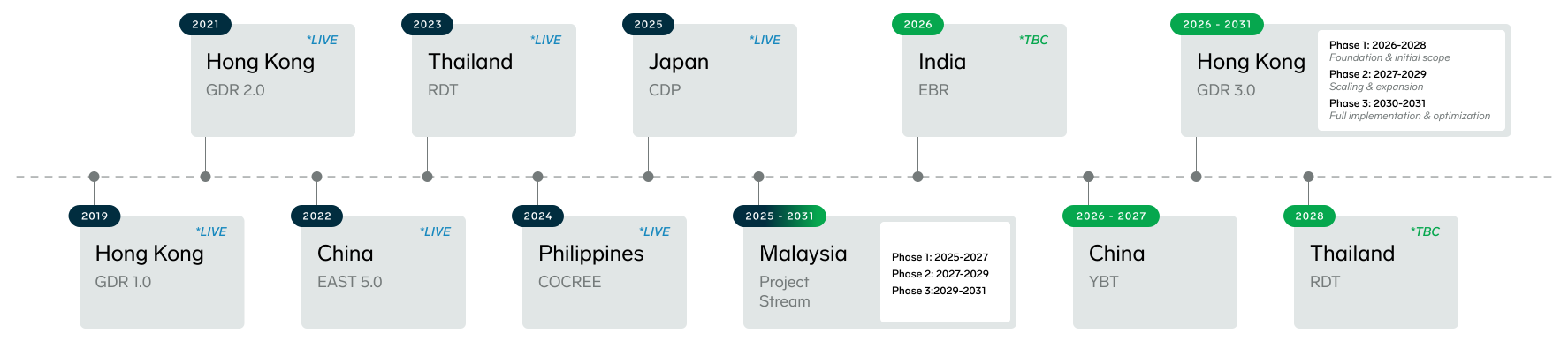
The momentum across the APAC region is clear and accelerating, as illustrated by the increasing frequency of key granular data initiatives. The latest developments are building on a global granular data wave, with each jurisdiction providing its own window into the evolving future of supervision.
Hong Kong’s GDR 3.0: Hong Kong’s approach offers a clear blueprint. The HKMA is positioning GDR 3.0 as a consultation-led "co-design." They are engaging the industry for consultation and collaboration, with an ambitious, phased rollout planned through 2028. The core message is that accountability for data accuracy now sits firmly with the banks, and the official data dictionary is the single source of truth.
Malaysia’s Project STREAM: Bank Negara Malaysia's (BNM) Project STREAM represents a similar overhaul. Its "Collect Once, Use Many" model requires a single, detailed data dump based on granular, transaction-level submissions, directly addressing the inefficiencies of managing multiple duplicative reports. The project aims to create an automated, end-to-end data collection mechanism using machine-readable formats and built-in logic checks on an agile platform designed to reduce errors and adapt efficiently to future changes.
Thailand’s RDT Phase 2: The Bank of Thailand’s (BOT) multi-phase regulatory data transformation (RDT) program replaces form-based reports with entity- and data-element-level submissions. Phase 2 expands the scope to include more group and data entities, requiring banks to map data elements to source systems, implement validations and align with BOT timelines.
China's Yi Biao Tong (YBT) System: The NFRA's YBT system in China signals the next wave of this trend. YBT is a large and unified regulatory data standard designed to gradually replace older systems. Its planned rollout from June 2026 to December 2027 reinforces the regional move toward standardized frameworks.
Other APAC initiatives: In India, RBI’s Element-Based Reporting (EBR) aims for "atomic" attribute-level submissions. In Australia, APRA's capital and liquidity reforms demand more sophisticated, data-driven analysis. Finally, in Japan, the Bank of Japan's Common Data Platform (CDP) advanced its granular data strategy by commencing full-scale data collection in March 2025.
Key challenges for banks
The shift to granular data is not without its difficulties. For reporting teams on the ground, it creates daily operational pain points: data issues are discovered too late, end-to-end lineage is not visible and work is scattered across disparate tools. However, these are symptoms of deeper architectural hurdles that banks must overcome to succeed:
Navigating a fragmented and modernizing landscape: Despite converging principles, the regulatory landscape remains fragmented. This complexity extends beyond jurisdictions maintaining their own taxonomies; it is compounded by the varying pace at which regulators are migrating to modern, agile and API-driven SupTech portals. For banks, this means the challenge is not just about adapting to different data formats, but also about overhauling legacy systems to support a diverse range of submission technologies and requirements, from older portals to new machine-to-machine integrations.
Closing critical data governance gaps: The move to granular data reporting exposes any and all weaknesses in data quality, governance, and lineage. This transition requires data accuracy, consistency, and full traceability to ensure compliance, placing immense pressure on banks' internal data frameworks and manual processes throughout the reporting lifecycle.
Building resilience for constant regulatory change: The phased nature of these rollouts, combined with the trend toward on-demand data requests from regulators, requires more than just an agile architecture — it demands a fundamentally new approach. To manage frequent updates and short implementation windows, banks must establish a scalable reporting infrastructure capable of handling both regulatory changes and vast data volumes. This is impossible to do with manual processes. Therefore, modern architecture must have intelligent automation embedded to augment human oversight and enable proactive governance at scale.
Viewing compliance as a mere burden is now a liability in today’s dynamic regulatory environment. The shift to granular data presents a clear opportunity to transform this reactive function into a strategic advantage. It requires an enterprise-grade architecture designed to adapt to constant regulatory change, enabling true Straight-Through-Reporting and unlocking lasting efficiency and resilience.
Philipp Hühne
General Manager APAC
Regnology
From mandate to mastery: An enterprise-grade architecture for future-proof compliance
The regulatory reset in APAC, driven by granular data mandates, marks a definitive break from the past. Overcoming its challenges requires more than just a reporting tool; it demands an enterprise-grade architecture that financial institutions can rely on to operate safely, efficiently, and strategically.
Successfully navigating this transition means moving beyond fragmented systems to a unified, cloud-native platform. This platform must be built on a proven granular data model, such as the Regnology Granular Data Model (RGD), which has been continuously and expertly refined over 30 years to align with supervisory expectations. A tested data model of this caliber eliminates the need for reconciliation, enabling rapid time-to-value and ensuring compliance. The architecture can then be elevated by an intelligent layer, such as Regnology’s RGI, which combines agentic AI with robust human-in-the-loop governance. This layer orchestrates the entire lifecycle — from data ingestion to final submission — to achieve true Straight-Through Reporting (STR).
By investing in a future-ready reporting architecture today, financial institutions can move from a reactive compliance posture to a proactive one. This represents more than just adapting to evolving regulations; it is about transforming a regulatory burden into a strategic advantage that delivers lasting efficiency and resilience.
Iyo Bank transforms regulatory operations with Regnology Reporting Hub
Discover how banks move from fragmented and manual spreadsheets to unified intelligence with Straight Through Reporting, meeting supervisory demands for speed and data granularity.
The next era of Regulatory Risk and Reporting powered by Agentic AI
The future of regulatory risk and reporting isn’t just automation: it’s intelligent orchestration. In our new whitepaper with Chartis, we detail how financial institutions can build a true strategic capability.
Navigate the global shift to Granular Data Reporting (GDR) with Regnology. Our expert analysis covers key initiatives from the ECB to HKMA and shows how to lower compliance costs.



 DE
DE  FR
FR 

