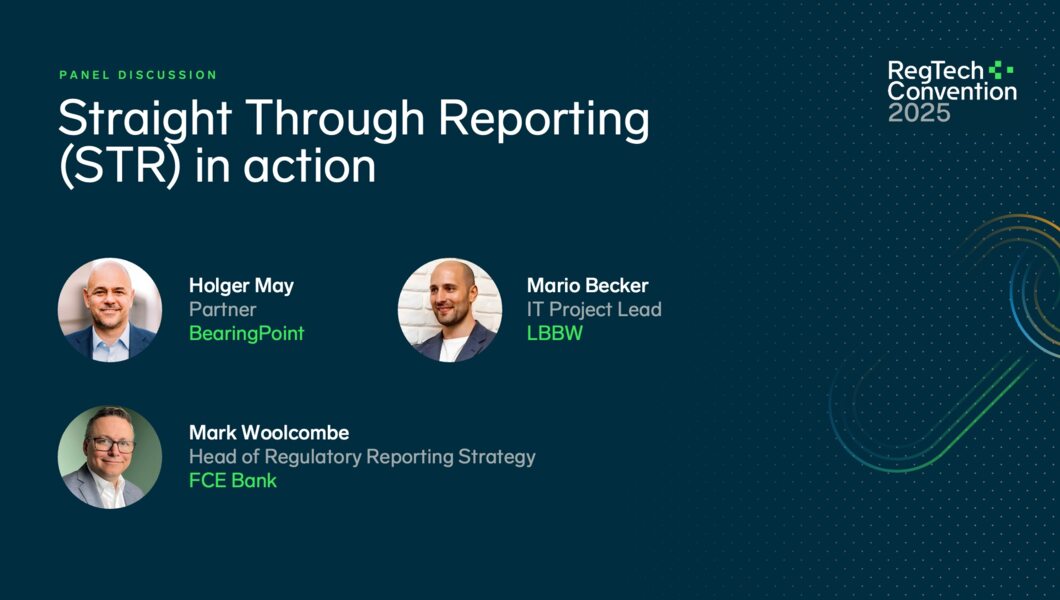
From fragmented compliance to unified intelligence
Inspired by the success of Straight Through Processing (STP) in capital markets, the financial industry is now poised for its next evolution: Straight Through Reporting (STR). This represents a pivotal shift from today's fragmented, labor-intensive compliance toward a seamless, intelligent, and data-driven regulatory ecosystem.
The opportunity now lies in translating this vision into practice. BearingPoint recently surveyed more than 50 EU banks and found that over 90% still rely on spreadsheets to meet
regulatory demands, the moment is ripe to strategically move beyond these legacy processes and unlock new efficiencies.
This panel focuses on what it takes to close that gap—examining how banks are rethinking operating models, integrating technology and processes, and mobilizing their organizations to build a resilient, end-to-end STR capability and automated regulatory reporting.
"Legacy complexity is the biggest barrier to Straight Through Reporting. Many banks operate dozens of aging systems, some so old that no one fully understands their logic. Every additional system adds handovers, cost, delays, and error risk. The only way to scale is to harmonize data structures and system architecture—moving away from fragmented setups toward integrated platforms that streamline processes and eliminate redundancy."
Mario Becker, IT Project Lead, LBBW
"Regulators are becoming less and less patient about when they expect returns and raise queries. A few years ago, we had weeks to respond; now they expect answers within 48 hours—or even a single day. That means banks must invest in processes and quality to operate at supervisory speed."
Holger May, Partner, BearingPoint
"It was that initial bit of FSA liquidity reporting that started our journey toward being able to report much faster to the regulator. You can’t achieve that using a spreadsheet and pulling together manual information, so we had to start investing in our data infrastructure to deliver it. More recently we've had AnaCredit, and now we’re looking forward to IReF and BIRD."
Mark Woolcombe, Head of Regulatory Reporting Strategy, FCE Bank

IT Project Lead LBBW

Partner BearingPoint

Head of Regulatory Reporting Strategy FCE Bank
© 2026 Regnology Group GmbH All Rights Reserved
 DE
DE  FR
FR