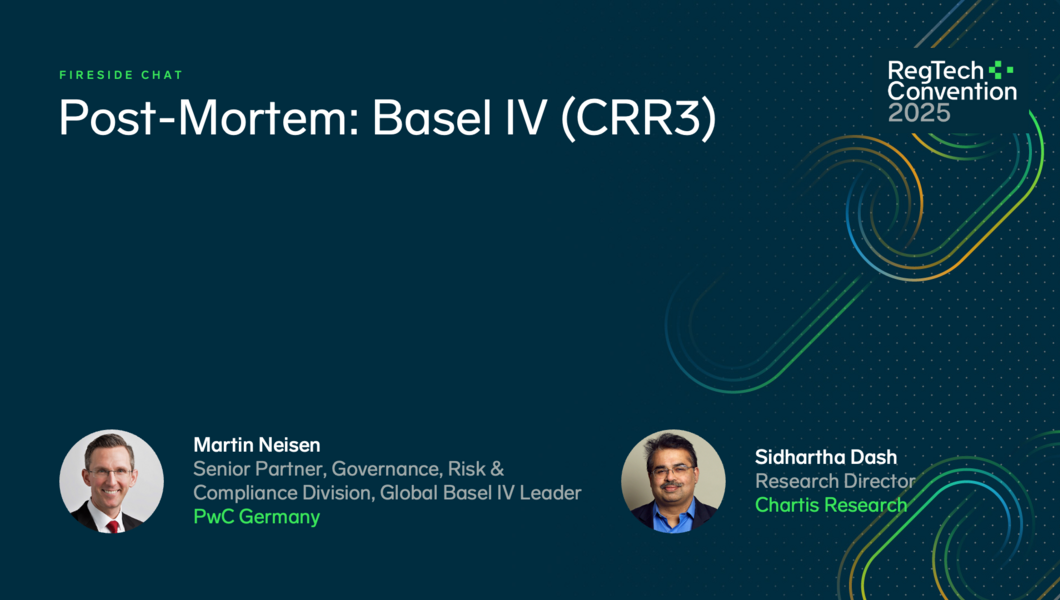
Redefining the architecture of modern capital strategy
The implementation of the Basel IV, known variously as the Capital Requirements Regulation III (CRR3) and Basel 3.1, represents one of the most significant recalibrations of bank capital requirements since the global financial crisis. Marked by delays, uncertainty, and significant national discretions, the new framework is reshaping the strategic landscape of banking.
This session distills insights from early implementation across jurisdictions—Canada, Hong Kong, and Singapore—and contrasts them with evolving developments in Europe, the United States, and the United Kingdom, where Basel 3.1 proposals reflect a more tailored adoption of the framework.
Leading industry experts dissect the implementation process, share critical lessons learned, and explore the future of prudential regulation. The panel highlighted key priorities for banks: upgrading data architecture to support reliable reporting, strengthening RWA (risk weighted asset) management as output‑floor pressures build, and leveraging plain‑vanilla securitization and synthetic risk transfer to ease rising capital demands.
"Sometimes banks really had to implement Basel IV twice. Subsidiaries in places like Canada, Hong Kong, or Singapore had to implement early, while Basel IV was not yet implemented in Europe. When the group requirements came later, much of the local work wasn’t compatible because national discretions were used differently."
“It has a huge impact on cost and complexity when you implement something locally and then again at group level. That will increasingly be the cost of doing banking globally.”
Martin Neisen, Senior Partner, Governance, Risk & Compliance Division, Global Basel IV Leader, PwC Germany
"Those institutions that approached Basel implementation through a data‑architectural lens — understanding the structure of the data and the mechanics of storage, quality, and lineage — were faster off the block than those that focused only on templates."
Sidhartha Dash, Research Director, Chartis Research

Senior Partner, Global Basel IV Leader PwC Germany

Research Director Chartis Research
© 2026 Regnology Group GmbH All Rights Reserved
 DE
DE  FR
FR