The path to a harmonized regulatory data framework
Across jurisdictions, supervisors and financial institutions converge on a common ambition: reporting that is accurate, timely, and adaptable. The industry is moving from template-based aggregation toward granular, standardized data models—a shift that redefines how data is collected, processed, and used.
To make this transformation work, it is essential to define granularity—agreeing on the level of detail and shared semantics that enable straight-through reporting (STR) and unlock multi-purpose data for risk, policy, and supervisory insights.
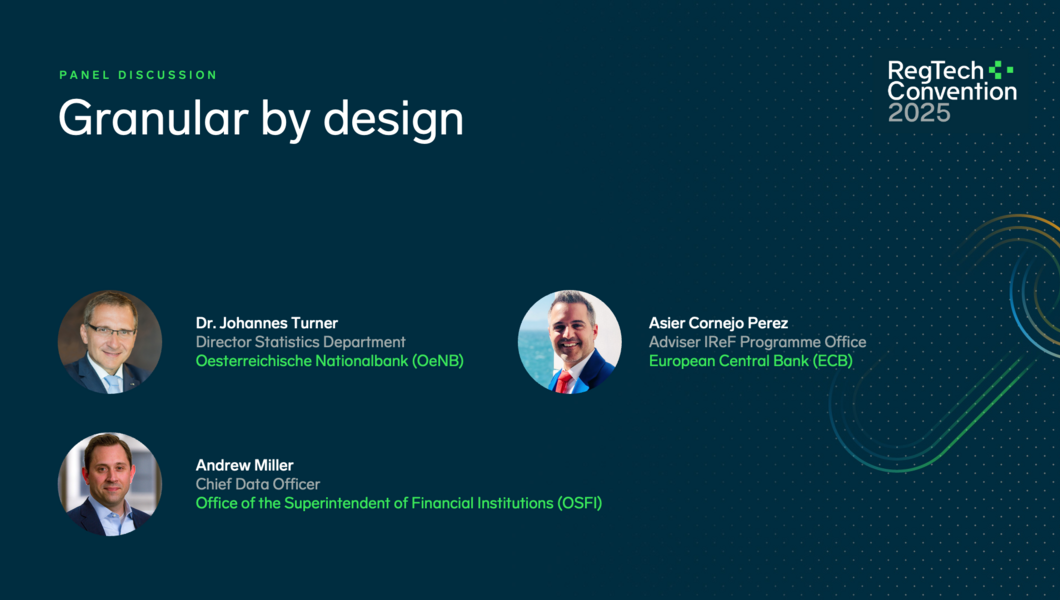
In this session, senior leaders from the European Central Bank (ECB), the Oesterreichische Nationalbank (OeNB), and Canada’s Office of the Superintendent of Financial Institutions (OSFI) explore what it takes to turn this ambition into reality.
“Granularity is the foundation of all future developments: straight-through reporting, seamless reporting, and beyond. It’s one of the key factors to enable multi-use of data. If we want to move from templates and aggregates to a taxonomy-based, standardized approach, we must go more granular.”
Dr. Johannes Turner, Director Statistics, Department, Oesterreichische Nationalbank (OeNB)
"Granular by design isn’t just about data—it’s about the entire supervisory technology stack. You need aligned processes, modern systems, and the right skills to collect, analyze, and act on granular information."
Andrew Miller, Chief Data Officer, Office of the Superintendent of Financial Institutions (OSFI)
“We can’t just dump all the data and expect AI to magically deliver the answers. We need to start from a good enough base and move step by step. That means working together, industry and regulators, on definitions, processes, and learning, especially given the differences across countries and institutions.”
Asier Cornejo Perez, Adviser IReF Programme Office, European Central Bank (ECB)

Director Statistics Department Oesterreichische Nationalbank (OeNB)

Chief Data Officer Office of the Superintendent of Financial Institutions (OSFI)

Adviser IReF Programme Office European Central Bank (ECB)
© 2026 Regnology Group GmbH All Rights Reserved
 DE
DE  FR
FR