



Liquidity risk measurement and monitoring tools

Effective liquidity risk management has moved beyond meeting static regulatory thresholds. In an environment of sudden interest rate shifts, market volatility, and digital depositor runs, institutions must understand how their liquidity profile behaves under stress and ensure they can mobilize sufficient funding and collateral immediately.

Basel III is a global regulatory capital and liquidity framework developed by the BCBS. The framework ensures that financial institutions hold sufficient liquid assets and stable funding to withstand economic stress by combining quantitative liquidity standards with supervisory reviews and market disclosures. Basel III is composed of three pillars.

  • Pillar 1 -  Minimum quantitative standards: Liquidity Coverage Ratio (LCR) and Net Stable Funding Ratio (NSFR) set the baseline for short-term resilience and long-term structural funding stability. Both carry a strict 100% minimum requirement.
  • Pillar 2 -  Supervisory review: Regulators evaluate risks that standard quantitative ratios miss. This process centers on the banks' internal liquidity adequacy assessment process (ILAAP), stress testing frameworks, and supervisory reviews.
  • Pillar 3 - Market discipline: Prescribed disclosure rules mandate transparency, giving market participants a clear view of an institution’s liquidity and funding risks.
Liquidity Coverage Ratio

Liquidity Coverage Ratio (LCR) measures the short-term resilience of a bank’s liquidity risk profile. It requires a bank to maintain an adequate stock of high-quality liquid assets (HQLA) that can be converted instantly into cash to cover net outflows during a severe, regulator-defined 30-calendar-day stress scenario.  

Although maintaining an LCR of 100 percent or above is a regulatory mandate, a static ratio is a lagging indicator. In a real crisis, standardized assumptions regarding deposit run-off rarely reflect actual behaviors. Forward-looking institutions must continuously stress-test their HQLA monetization pipelines and look beyond the basic standardized calculation.

Net Stable Funding Ratio

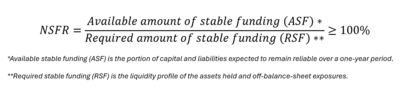
Net Stable Funding Ratio (NSFR) focuses on structural balance-sheet stability over a longer one-year horizon. It requires banks to fund their long-term assets and activities with stable, reliable sources of capital, reducing over-reliance on highly volatile, short-term wholesale funding. The NSFR must be reported atleast quarterly.

Additional liquidity monitoring metrics

Standardized ratios like LCR and NSFR provide a high-level view of resilience, but they can mask near-term cash mismatches and funding concentrations. To close this gap, supervisors use additional liquidity monitoring metrics (ALMM) to track specific vulnerabilities.

  • Contractual maturity mismatch: Mapping contractual cash inflows and outflows across discrete time bands to flag sudden, near-term funding cliffs.
  • Funding concentrations: Tracking reliance on specific counterparties, funding instruments, and foreign currencies to prevent single points of failure.
  • Changes in funding costs: Monitoring price movements for various funding maturities, which often serve as an early warning sign of market-wide or institution-specific stress.
  • Counterbalancing capacity: Identifying concentrations within the liquid asset buffer itself to prevent over-reliance on a single sovereign issuer or asset type.

Managing regional reporting differences

While the Basel rules are international, their implementation and supervisory reporting requirements differ significantly across regions. This makes liquidity compliance as much a data management challenge as a risk management one.

European Union

Under the Capital Requirements Regulation (CRR), the EBA mandates highly structured reporting requirements within the COREP framework. This includes standardized templates for LCR (C 72 series), NSFR (C 80 series), and ALMM (C 66 series).

United Kingdom

The Prudential Regulation Authority (PRA) maintains the Basel standards but enforces detailed cash-flow reporting via the PRA110 template. The UK framework places particular emphasis on firms’ ability to identify emerging liquidity gaps, mobilize liquid assets quickly, and produce sufficiently granular liquidity information under stressed conditions.

United States

The Federal Reserve and other U.S. regulators tailor liquidity requirements based on bank size. A key feature of the U.S. regime is the inclusion of a daily maturity mismatch calculation within the LCR framework, which prevents banks from offsetting near-term deficits with cash inflows that fall late in the 30-day window.

Canada & APAC

Many jurisdictions across these regions have adopted Basel standards but adapted reporting frequencies, intraday monitoring expectations, and local data formats to their domestic markets, requiring multinational banks to manage highly diverse reporting calendars.

Operational hurdles for banks in liquidity management

Financial institutions face several challenges that are particularly acute in the context of liquidity risk monitoring:

Depositor behavior is accelerating

The financial stress of recent years proved that deposits can move almost instantly in an era of mobile banking and rapid social communication. Historical run-off assumptions rarely match modern reality.

Monetization is not automatic

Holding a buffer of HQLA is only useful if a bank can mobilize it. Banks must actively test their ability to convert assets under stress, manage haircut calculations, and establish clear operational pipelines with central banks.

Intraday visibility is a blind spot

Standard LCR and NSFR metrics do not capture intraday dynamics. Banks must be able to meet payment and settlement obligations in real time throughout the day, which requires instant visibility into cash and collateral across different legal entities and payment networks.

Supervisors demand speed

Reporting frameworks like the PRA110 require highly granular cash-flow details. In times of stress, regulators often demand these complex reports on a daily or ad hoc basis, making manual data aggregation impossible

Bridging risk and regulatory reporting with Regnology

Regnology's integrated suite of solutions is designed to help financial institutions address liquidity risk across regulatory reporting, risk measurement, and internal risk management. By combining granular data, regulatory reporting, and forward-looking analytics, institutions can move from a static, compliance-focused view towards a more dynamic approach to liquidity risk.

Regulatory Reporting and Disclosure

Regnology Reporting Hub (RRH) supports end-to-end regulatory reporting for liquidity requirements such as LCR, NSFR, and ALMM, from data ingestion using a unified data model and validation through to regulatory submission – including jurisdiction-specific reporting requirements, such as the EBA COREP liquidity templates in the EU and granular liquidity reports, like the PRA110, in the UK, while supporting consistent data across supervisory reporting and public disclosure.

Liquidity risk management and ILAAP

Regnology Risk Hub (RRiH) provides analytical capabilities for liquidity risk management, including cash-flow modelling, behavioral assumptions, stress testing, and scenario analysis. Its granular, contract-level approach supports ILAAP processes and helps institutions analyze maturity mismatches, funding concentrations, and other liquidity risks beyond the regulatory ratios alone.

You may also be interested in

  • Internal Capital Adequacy Assessment Process (ICAAP) and Internal Liquidity Adequacy Assessment Process (ILAAP)

    Regulatory Topic

    Internal Capital Adequacy Assessment Process (ICAAP) and Internal Liquidity Adequacy Assessment Process (ILAAP)

    An expert guide to ICAAP and ILAAP with a complete breakdown of the latest Pillar 2 rules on capital adequacy, liquidity risk, integration, and stress testing, for financial institutions.

    Read more
  • Stress testing for banks

    Regulatory Topic

    Stress testing for banks

    An analysis of how bank stress testing bridges internal risk frameworks and regulatory oversight, covering key challenges in capital and liquidity planning.

    Read more
  • Built for Stress: Rethinking Liquidity Management in a new era of risk

    Insight

    Built for Stress: Rethinking Liquidity Management in a new era of risk

    Learn why financial institutions must evolve their funding liquidity strategies to thrive in a climate defined by volatility, regulatory pressure, and rising depositor stress.

    Read more

Contact us