
What CFOs need to know about the new P&L structure, MPM governance, and the architectural shift.

The introduction of IFRS 18 marks the most significant change to financial statement presentation in a generation. Born from long-standing investor demand for greater comparability, it represents a fundamental shift for banking finance leaders in how financial performance is measured, categorized, and communicated. With an effective date set for periods beginning on or after January 1, 2027, banks face a narrowing window to adapt their data architectures, accounting operations, and reporting systems.
While the changes will ripple through regulatory frameworks such as FINREP, the core challenge lies in accounting operations. Mastering the new principles for classification, presentation, and disclosure is paramount.
Reporting Framework 4.4 update
On 12 October 2026, the EBA published the final technical package for Reporting Framework 4.4 Phase 1, including the IFRS 18-aligned FINREP module. The first reference date for these FINREP templates is March 2027. Authorities may still allow voluntary earlier use. This guide focuses on the accounting and data implications banks need to manage ahead of that change.
To deliver the comparability investors have demanded, IFRS 18 replaces IAS 1's flexibility with a structured, principles-based framework. For practitioners, this means moving beyond form and mastering the new logic of how performance is categorized and presented.
The standard requires all income and expenses to be classified into one of three primary categories (in addition to taxes and discontinued operations). Understanding the logic is key:
This clear structure creates two new mandatory subtotals: 'Operating profit or loss' and 'Profit or loss before financing and income taxes', which will become a benchmark for performance analysis. In the FINREP report this will be reflected by the categories “OPERATING PROFIT or LOSS” and “OPERATING and INVESTING PROFIT or LOSS” respectively.
The most consequential accounting judgment for banks is the assessment of "specified main business activities." IFRS 18 recognizes that for a bank, providing financing to customers and investing in assets is its core business. This allows for a more faithful representation of performance by permitting certain items to be classified in the operating category.
For a corporate, interest expense on a loan is a financing cost. For a bank, the interest expense on liabilities used to fund its loan portfolio is an operational cost. IFRS 18 allows these to be matched in the operating category, providing a cohesive presentation of Net Interest Income (NII) within the results of core operations. However, there are some exemptions to this classification, e.g., when amounts are produced to meet the requirements of an IFRS standard they could end up in the financing category for some instances. This principle also extends to insurers and investment property companies, allowing their core investment returns to be classified as operating. All the IFRS 18 changes listed below impact FINREP reporting.
|
Item |
Under IAS 1 |
IFRS 18 mandated classification |
Rationale |
| Equity-accounted investments | Often included in or near operating profit, the practice varied. | Investing category | A significant change. The share of profit/loss from associates and JVs is now explicitly non-operating. Unless the main activity is investing in financial assets (insurance, banks, asset management firms…). |
| FX differences | Classification varied; often grouped in an "other" line item. | Follows the "lead category" | Must be traced to the underlying item (e.g., FX on trade payables is operating; FX on foreign debt is financing). |
| Derivatives (Hedging) | No mandatory structure, companies have flexibility. | Follows hedged item, with an exception |
If a single derivative hedges item is in multiple categories (e.g., operating and financing), the entire net gain/loss must go to the operating category to avoid "grossing up." |
| Goodwill | Could be presented within intangible assets. | Separate line item on Balance Sheet | A specific presentation change enhancing visibility for goodwill and goodwill impairment, confirmed as a driver for FINREP template F 01.1 changes. |
| Lease Liability Interest (IFRS 16) |
Practice varied; sometimes in NII. |
Financing category |
The interest expense on lease liabilities is now consistently classified as a financing cost, potentially impacting NII presentation. |
| Provision Discounting (IAS 37) | Practice varied. | Financing category | The unwinding of the discount on a provision (e.g., for litigation) is now a financing expense, separating it from the operational remeasurement of the provision itself. |
| Investments as non-main business activity | Practice varied. | Investment category |
If a financial institution considers investments as a non-core activity these invstments will be classified under the investment category. |
IFRS 18 fundamentally alters the governance around non-GAAP measures. Those "adjusted profit" figures, for example, adjusted EBITDA, adjusted operating profit, from investor presentations are now formally defined as MPMs and included in the audited financial statements.
This is not just a disclosure exercise; it is a new frontier for the audit committee. MPMs must be:
MPM Governance & Control Process

The granular, high-quality, and validated data foundation required to comply with IFRS 18 is the exact same foundation the EBA needs for its integrated, 'report-once' supervisory architecture. The investment in IFRS 18 is, therefore, a direct down payment in a more efficient regulatory future.
Frederik Roeland Director Product Management
Regnology
The accounting principles detailed above are the direct drivers of the significant operational impact under IFRS 18.
Demand for data granularity
The classification rules require a level of granularity that most legacy systems do not support. For instance, the requirement to trace Foreign Exchange (FX) differences back to the underlying item on an instrument-by-instrument basis is a significant technical hurdle. Similarly, a single financial contract may now have dual characteristics (e.g., partly operating, partly financing), requiring data capture and splitting at the contract level that many systems are not built to handle. If a finance system cannot capture and split this data at the contract level, the reporting process will fail.
The Chart of Accounts
To achieve this detailed dimensionality, banks operating on existing General Ledgers face a massive redesign of their Chart of Accounts. Accommodating the new categories and disclosures could exponentially inflate the size of an already heavy CoA. This forces a strategic choice: either undertake a technically burdensome and risky expansion of the legacy GL, or evolve to a more flexible, dimensional data architecture.
The burden of parallel runs
The mandatory retrospective application requires finance teams to simultaneously run and reconcile multiple frameworks during the transition: FINREP vs. IFRS 18, IAS 1 vs. IFRS 18, and MPMs vs. IFRS 18 operational figures. This places an enormous strain on manual processes and creates significant reconciliation risk. Industry feedback on the EBA's IFRS 18 proposal already highlights concerns that the new breakdown by category in the detailed FINREP templates (F16 and F45) will be operationally burdensome and complicate reconciliation back to the main P&L template (F 02.00) and the primary financial statements. This is a prime example of how a change designed to increase transparency can inadvertently create significant operational complexity.
With Reporting Framework 4.4 Phase 1 now published, the IFRS 18-aligned FINREP templates have a first reference date of March 2027. The EBA continues to support voluntary earlier application so institutions can align statutory and supervisory reporting during the transition.
While mastering accounting transformation is the immediate priority, the strategic payoff lies in its connection to the regulatory landscape. The granular, high-quality data foundation required for IFRS 18 is the exact same foundation the EBA needs for its integrated, "report-once" supervisory architecture. The investment in IFRS 18 is, therefore, a direct down payment in a more efficient regulatory future.
timeline for transformation
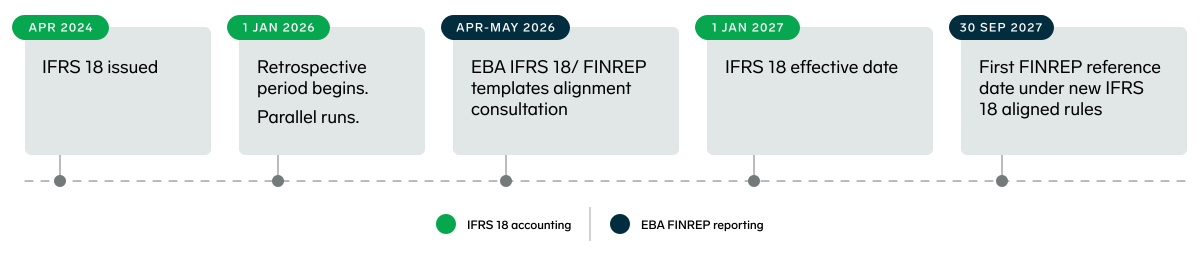
Navigating this transition successfully requires a forward-looking approach to your finance architecture, built on three core principles:
The road to 2027 is complex, but it presents a rare opportunity. The challenges raised by industry, the need for both standardization and flexibility, the risk of complex reconciliations, and the pressure on legacy systems all point to the inadequacy of traditional, account-based architectures. Success requires a paradigm shift.
Regnology Finance Hub (RFH) is purpose-built for this new paradigm. By operating on a granular, contract-level data layer and decoupling the Chart of Accounts from reporting logic, RFH transforms the IFRS 18 challenge from a daunting operational obstacle into an opportunity for banks to modernize and optimize their entire financial reporting architecture.
Insight
The why, what, and how of modernizing the Finance function, from eliminating manual processes to enabling predictive analytics.
Read moreInsight
How a leading European Bank transformed its Finance function to align data and accounting.
Read moreInsight
Packed with practical guidance and proven success stories, our IFRS 9 toolkit empowers your team to achieve compliance with confidence while improving efficiency.
Read more
© 2026 Regnology Group GmbH All Rights Reserved
 DE
DE  FR
FR 

