
Banks’ Integrated Reporting Dictionary (BIRD)

Banks’ Integrated Reporting Dictionary (BIRD) is a common dictionary translating reporting requirements into banks' data and reporting processes. BIRD is a key building block of the ESCB integrated reporting strategy, alongside IReF and JBRC.
BIRD
Every time a statistical or supervisory regulatory framework is updated or a new one comes into existence, banks are left to their own devices to interpret it, extract the data from their internal systems and transform it appropriately to deliver a resulting data as per the regulation. It is not always straightforward, which source data to use and how to process it to produce the number required in Legislation X, Table Y, Cell Z. The greater the misalignment among banks regarding the meaning of specific sections within a regulatory standard, the more questionable is the quality of the output data and the more difficult are the comparisons among banks. In-depth study of revised or new legal acts is a costly and time-consuming process for each bank.
Banks’ Integrated Reporting Dictionary (BIRD) is a methodology and data model, which is being developed in close collaboration by a group of members from the ECB, euro area NCBs and the banking industry software solution providers – including Regnology. The aim of BIRD is to alleviate the reporting burden for banks, “to help reporting agents efficiently organize information stored in their internal systems and fulfil their reporting requirements”.
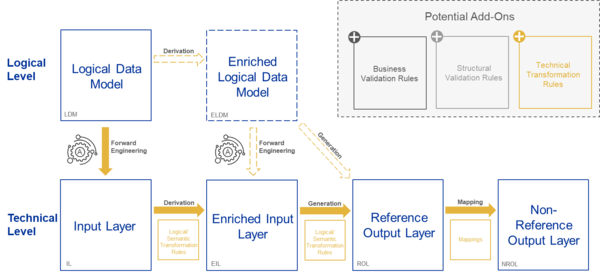
Source: ECB Ecosystem - BIRD Methodology
Starting in November 2026, BIRD will transition to a permanent, stable service framework. For banks and regulators, the shift to a service-oriented operational framework establishes a reliable, step-by-step cycle for updating reporting standards - running from initial joint planning and modeling all the way through thorough testing and formal releases.
To support this transition, BIRD metadata will be delivered using the new SMCube 2.0 standard from November 2026. The technical upgrade is a major step in the Eurosystem’s push to align and standardize banking statistics and supervision. For teams working on the migration, the ECB has released official SMCube Information Model guidelines and practical examples to help with the transition.
As the BIRD is a technical/operational level concept and not a regulatory requirement, it is also not a prescribed IT tool.
The BIRD is being designed to generate outputs that are compliant with the reporting schemes of secondary statistics; however, it does not consider how these requirements are fulfilled in the national collection frameworks. Significant country-specific adjustments may be required to implement the BIRD at a national level. Thus, most of the benefits of BIRD will only be achieved if the IReF and the BIRD are implemented together.
The ECB's long-term strategy for banks' regulatory data reporting is to create a single standartised reporting framework, with BIRD and IReF as two main pillars. BIRD will be extended for the possible country-specific items and facilitate local extensions outside of IReF scope as well, following the same principles allowing minimal redundancies across Eurozone countries.
© 2026 Regnology Group GmbH Tous droits réservés
 EN
EN  DE
DE