


From Control to Intelligence in Regulatory Reporting

The Agentic Gap is Regnology’s AI readiness snapshot of regulatory reporting in 2026.

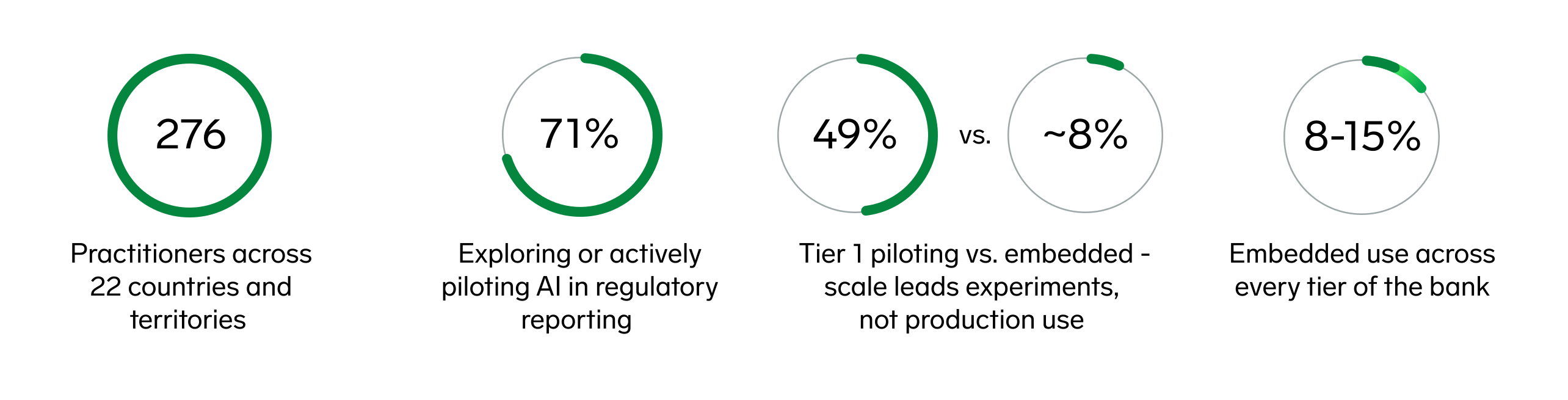
Based on feedback from 276 practitioners across 22 countries, with a large majority inside financial institutions, it reveals that regulatory reporting has reached a tipping point: while 71% of organizations are either exploring or piloting AI, only 16% describe AI as embedded in operations.

Scale buys experimentation, not adoption. The gap that matters lies between piloting a use case and trusting AI in the reporting cycle, and not by the size of the institution.
What our research shows

Provides citable benchmarks from the 2026 snapshot - framed for leaders diagnosing where experimentation ends and trusted use begins. 

  • The biggest barrier is a 'trust gap' between pilot and production.
  • AI is seen as a tool for modernization, not a separate goal.
  • Initial AI investment is highly focused around data analysis and workflow automation.
  • A significant economic incentive exists for targeted agentic workflows.

Inside the report 

The report outlines a practical approach to guide organizations from maturity diagnosis to governed production, addressing several critical areas: 

  • 01

    Where financial institutions stand today

    Adoption stages from exploratory through piloting to embedded — and why the meaningful gap lies from pilot to trusted use, not by institutional size.

  • 02

    What’s driving AI investment

    How modernization, data quality, and economics shape where AI attention is concentrated in the reporting value chain.

  • 03

    Where the barriers remain

    Explainability, auditability, domain translation, supervisory expectations, plus the data and governance foundations that must precede automation.

  • 04

    How institutions can move the needle

    A value-versus-readiness framework, principles for matching authority to workflow, and a path from pilot to production.

FAQs

What is the agentic gap in regulatory reporting?

The agentic gap is the distance between piloting a use case and trusting it inside the reporting cycle, not the distance between large institutions and small ones. Scale buys experimentation; trust is earned separately, through governed and auditable workflows that keep accountability with people.

Do larger institutions lead on AI adoption in regulatory reporting?

They lead on experimentation, not on embedded use. Among the largest institutions, 49% are piloting AI, yet embedded use sits at around 8% — broadly in line with other size bands, where embedded use remains flat at roughly 8–15% across every tier.

What share of reporting spend could agentic AI address?

Regnology's research estimates that roughly 15–25% of regulatory reporting spend could be addressable by agentic workflows, concentrated where manual effort remains substantial across a small number of high-value activities.

Who should read this report?

Head of regulatory reporting, Chief Data Officers, Chief Risk and Compliance Officers, Chief Finance Officers, Chief Technology Offficers, Chief Operating Officers, Transformation leaders, Supervisory authorities responsible for AI adoption.

Download the Agentic Gap report

The Regnology AI readiness snapshot

Contenus similaires

  • The next era of Regulatory Risk and Reporting powered by Agentic AI

    Contenu

    The next era of Regulatory Risk and Reporting powered by Agentic AI

    The future of regulatory risk and reporting isn’t just automation: it’s intelligent orchestration. In our new whitepaper with Chartis, we detail how financial institutions can build a true strategic capability.

    Lire
  • Transforming modern supervision

    Contenu

    Transforming modern supervision

    Financial supervisory authorities are increasingly leveraging cloud-native infrastructure, granular data, and AI-enhanced oversight to transition toward a more data-driven, and forward-looking approach to supervision.

    Lire
  • The rise of machine-readable and AI-enabled regulatory reporting

    Contenu

    The rise of machine-readable and AI-enabled regulatory reporting

    European regulatory authorities are increasingly aligning towards a unified, interoperable, data-centric reporting infrastructure. Read our mid-year analysis to see how these initiatives are laying the groundwork for an AI-enabled regulatory ecosystem.

    Lire

Contactez-nous